
Say “I’m fixin’ to go to the store” in most of the country and people know what you mean. Say it in the mountains and nobody blinks. That’s Appalachian English, and it’s a real dialect with its own rules, not a lazy version of the standard kind.
Here’s what the words mean, where they came from, and how they sound on the page.
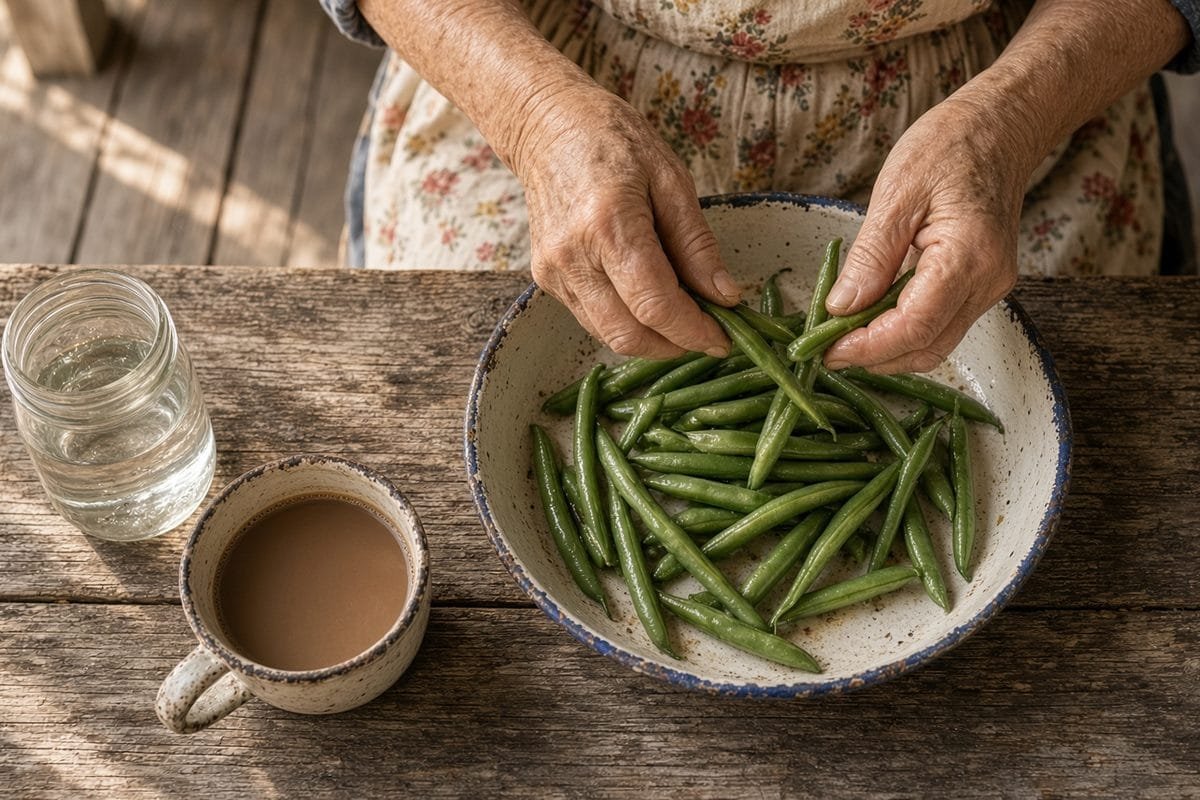
The images in this post are AI-generated illustrations.
It’s not Shakespeare’s English
You may have heard that mountain people speak the English of Queen Elizabeth’s day, kept alive because they lived cut off from everyone else. It’s a popular idea, and it goes back to the late 1800s. Scholars don’t accept it. A few old words like “afeared” did hang on, but they’re rare.
What the research shows is a mix. Linguist Michael Montgomery traced a good deal of Appalachian grammar to the Scots-Irish and to northern England. “Might could” and “young’un” are two of the examples he lists. The dialect also has older features and newer ones side by side, not a single frozen century.
Words you’ll hear
- Holler: a hollow, a small valley between mountains. (More on that in What is a holler?)
- Reckon: to suppose or figure. “I reckon it’ll rain.”
- Fixin’ to: about to. “They’re fixin’ to get married.”
- Yonder: over there, at a distance.
- Young’un: a child.
- Poke: a paper bag.
- Directly: later, when it suits. Not “right away.”
- Plumb: completely. “Plumb wore out.”
- Might could: might be able to. “I might could help you with that.”
Some of these, like “reckon” and “y’all,” are Southern in general and not just mountain. Others, like “poke” for a bag and “directly” for later, are more local.
A few rules of grammar
The dialect has its own patterns, and they’re consistent.
Plural subjects often take “was”: “they was there.” “Ain’t” shows up a lot more than in other American dialects. “Them” can stand in for “those,” as in “them are the pants I want.” Older speakers may put an “a” in front of a verb: “we was a-ridin’ it one day.” Researchers say that last one is fading with younger speakers.
None of this is random. It’s a system, and the people who use it follow it the same way each time.
Not one dialect
Appalachia covers a lot of ground, and the speech changes with it. The southern mountains sound closer to Southern American English in general. Northern Appalachia leans toward the speech of western Pennsylvania. Linguists argue over where to draw the lines. The mountains don’t have one accent.
How it sounds in Hymns of Blue Hollow
The characters in Hymns of Blue Hollow speak this way, spelled out on the page. A few lines from Book 1:
“I reckon you’ve got a gift for somethin’.”
“I’m fixin’ to get ya somethin’ to eat.”
“Ya took somethin’ that warn’t yers.”
“And I really like them young’uns of yers.”
You can see the whole toolbox: reckon, fixin’ to, dropped g’s, “warn’t” for wasn’t, “yers” for yours, and “them” doing the work of “those.” In the review copy of Book 1, “ain’t” turns up well over a hundred times. It’s how the people in the story would have sounded.
Get the next one
Enjoyed this? Join the Inner Circle with the signup form at the bottom of this page, and we’ll send you new articles about Appalachian history and the world of Blue Hollow. No spam.
Hear it for yourself
Book 1 of Hymns of Blue Hollow is set in the mountains of eastern Tennessee in 1941. See the books in reading order, or start with Book 1.
Sources
- Wikipedia, Appalachian English (which cites Michael Montgomery, “The Scotch-Irish Element in Appalachian English,” and Walt Wolfram and Donna Christian, Appalachian Speech, 1976)
- Dictionary of Appalachian English, University of South Carolina


